
Why Mastering JavaScript's Hidden Rules Makes You Debug Like a Pro
After three years of building React applications, I encountered a problem that changed my perspective on JavaScript entirely. I was implementing a newsletter subscription feature for ndustudenthub.com, and despite following best practices, something wasn’t working. The bug was subtle, intermittent, and impossible to Google effectively.
A mentor’s advice shifted everything: “Once you understand the principles, you can learn any syntax.” This led me down a path of discovering JavaScript’s fundamental concepts—execution context, closures, hoisting, the call stack, and the this keyword. These weren’t abstract academic concepts. They were the missing pieces that explained every confusing bug I’d encountered.
The Cost of Not Understanding Fundamentals
Most frontend developers, myself included, start by learning frameworks. We copy patterns, follow tutorials, and build functional applications without understanding what’s happening beneath the surface. This works—until it doesn’t.
When bugs arise that don’t match Stack Overflow solutions, we’re left guessing. We try random fixes, restart the dev server, maybe meditate😂, or restructure code hoping something will work. The real issue? We’re treating symptoms instead of diagnosing the root cause.
1. Hoisting: Why Variable Declarations Behave Unexpectedly
The Problem:
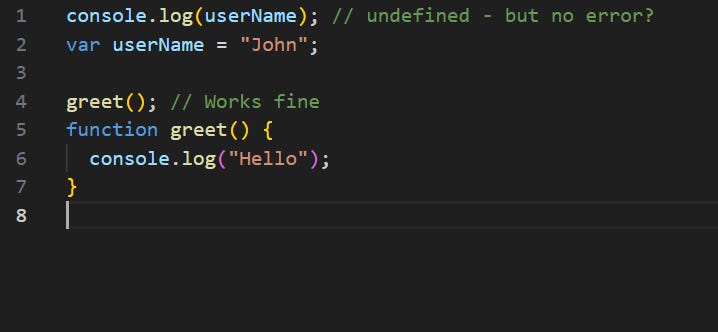
This behavior seems illogical. How can we reference variables and functions before declaring them?
What’s Actually Happening:
JavaScript hoists declarations to the top of their scope during the creation phase of the execution context. However, only declarations are hoisted—not initializations.
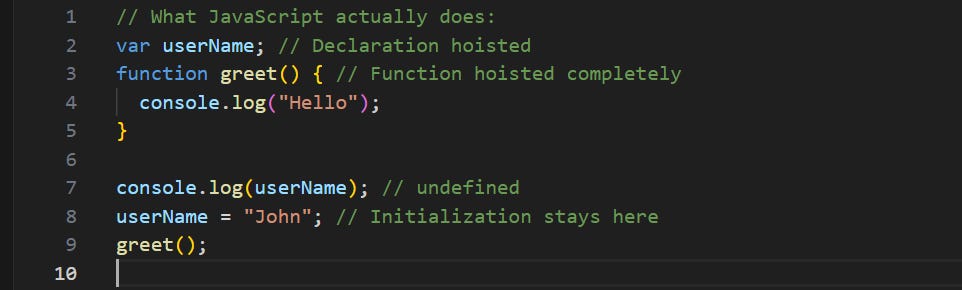
Debugging Impact:
Understanding hoisting helps you spot issues like:
- Variables accessed before initialization returning undefined instead of throwing errors
- Function expressions vs. function declarations behaving differently
- let and const creating Temporal Dead Zones that throw ReferenceErrors
Best Practice:

2. Closures: The Hidden Cause of Stale Data
The Problem:
This is one of the most common React bugs:
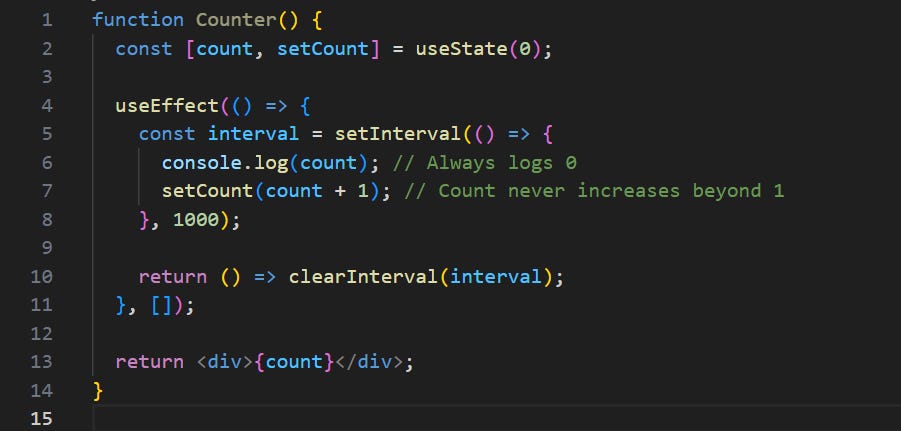
What’s Actually Happening:
The callback inside setInterval forms a closure over the initial value of count (0). Even as the component re-renders with new count values, the interval callback still references the original closure scope.
The Solution:
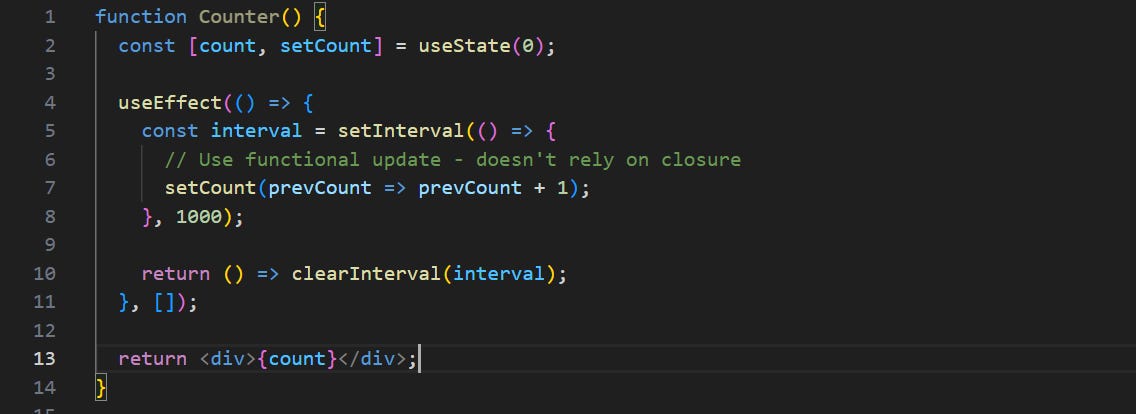
Debugging Impact:
Closures explain:
- Why event handlers have “old” state values
- Why variables in loops behave unexpectedly with var
- Why React’s useEffect dependencies matter
- How data persists across function calls
Understanding closures transforms debugging from “trying different dependency arrays” to “knowing exactly which scope your function accesses.”
3. The this Keyword: Context Loss in Event Handlers
The Problem:
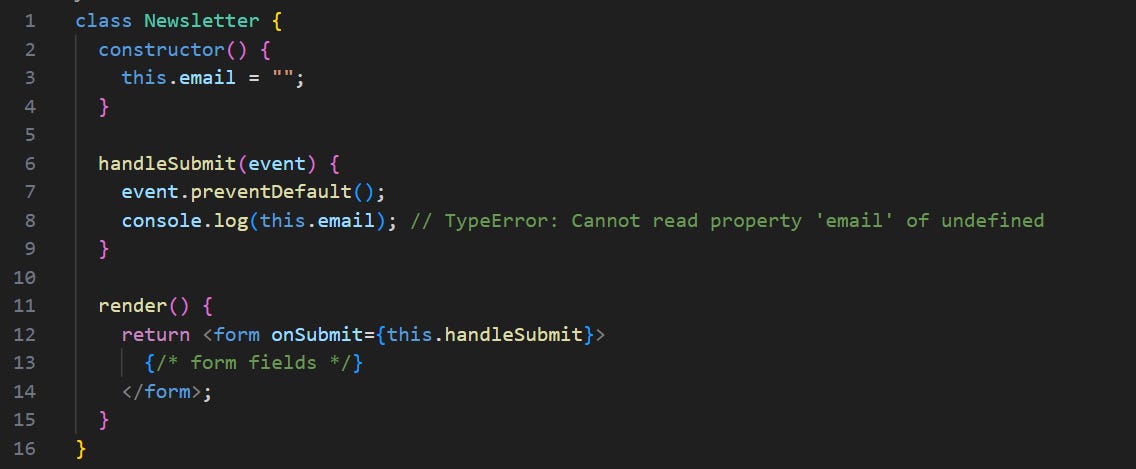
What’s Actually Happening:
In JavaScript, this is determined by how a function is called, not where it’s defined. When you pass this.handleSubmit to onSubmit, you’re passing just the function—without its context. When React calls it later, this is undefined.
The Solutions:
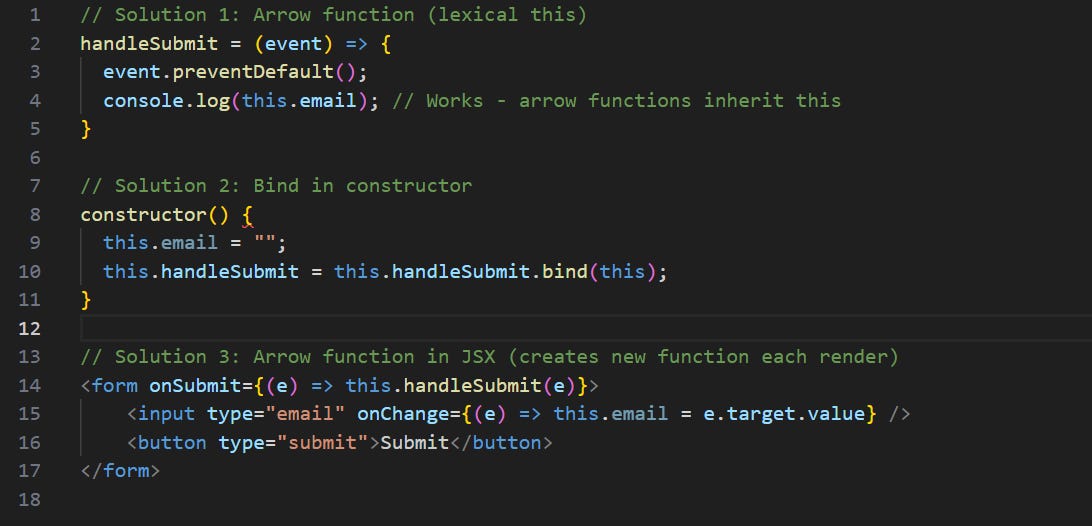
Debugging Impact:
Understanding this helps you:
- Predict when context will be lost
- Choose the right binding solution
- Understand why class components vs. functional components behave differently
- Debug “undefined is not a function” errors faster
4. Call Stack and Execution Context: Reading Error Messages Effectively
The Problem:
Uncaught RangeError: Maximum call stack size exceeded
at fetchUserData (app.js:45)
at processUsers (app.js:32)
at loadData (app.js:18)
Without understanding the call stack, this is just noise.
What’s Actually Happening:
JavaScript maintains a call stack—a data structure tracking function execution. Each function call pushes a new execution context onto the stack. When a function returns, its context is popped off.
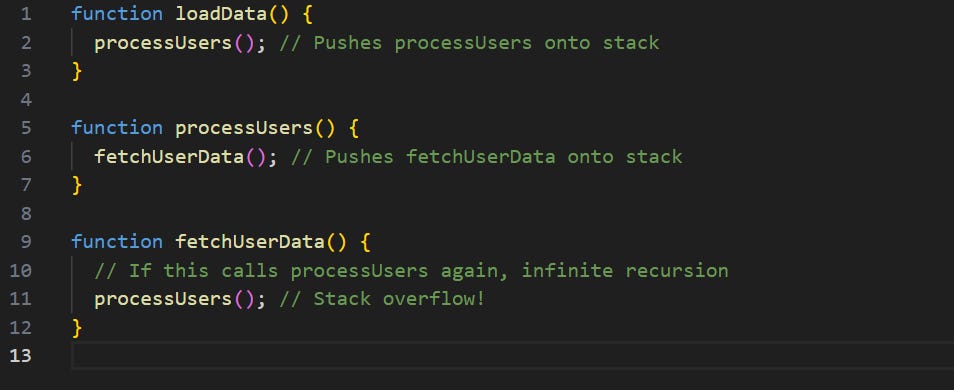
Debugging Impact:
Understanding the call stack means you can:
- Trace execution flow from error messages
- Identify infinite recursion immediately
- Understand why async code (promises, async/await) behaves differently
- Use debugger breakpoints more effectively
Best Practice:
Add meaningful function names and avoid anonymous functions in production:
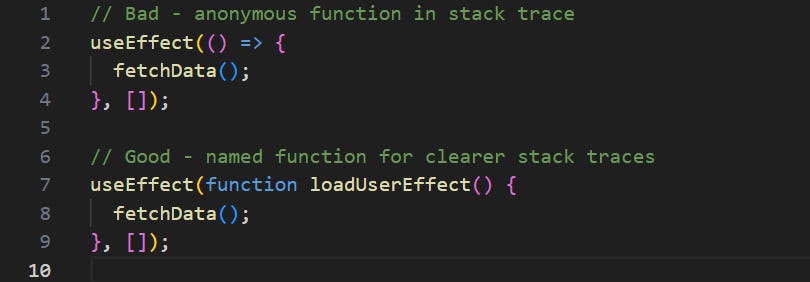
5. Execution Context: The Foundation of Everything
Execution context is the environment where JavaScript code is evaluated and executed. There are three types:
1. Global Execution Context: Created when your script first runs
2. Function Execution Context: Created when a function is invoked
3. Eval Execution Context: Created by eval() (avoid using)
Each execution context has two phases:
Creation Phase:
- Sets up the scope chain
- Creates the variable object (hoisting happens here)
- Determines the value of this
Execution Phase:
- Assigns values to variables
- Executes code line by line
Why This Matters:
Understanding execution context explains:
- Why hoisting works the way it does
- How closures capture variables
- Why this behaves differently in different contexts
- How the call stack manages multiple execution context
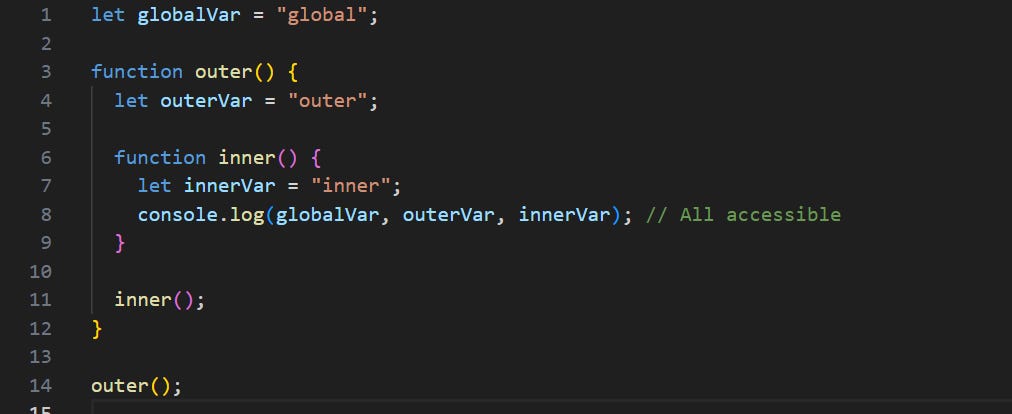
When inner() executes:
1. Inner execution context is created
2. Scope chain: inner → outer → global
3. Variables are resolved by traveling up the scope chain
4. This is how closures work under the hood
From Confusion to Clarity
Before understanding these principles, debugging felt like guesswork. I’d spend hours on issues that now take minutes to resolve. The newsletter feature that frustrated me? It was a closure issue with stale state in an event handler.
These concepts aren’t just theory—they’re practical tools that change how you read code, interpret errors, and architect solutions. When you understand execution context, you see why React hooks have rules. When you understand closures, you know exactly which dependencies your useEffect needs. When you understand this, you stop randomly trying .bind() everywhere.
Key Takeaways
1. Hoisting: explains why declarations can be used before they appear in code
2. Closures: are why your callbacks have “stale” data and why functional updates matter
3. The this keyword changes based on invocation, not definition
4. Call stack errors tell you exactly where execution went wrong
5. Execution context is the foundation that makes everything else make sense
The frameworks and libraries you use are built on these principles. Master them, and you won’t just write code that works—you’ll write code you understand. And that makes all the difference when things break.
What JavaScript concept finally “clicked” for you? Share your biggest debugging breakthrough in the comments.
#JavaScript #WebDevelopment #React #Frontend #SoftwareEngineering #CodingTips